
August 20, 2026
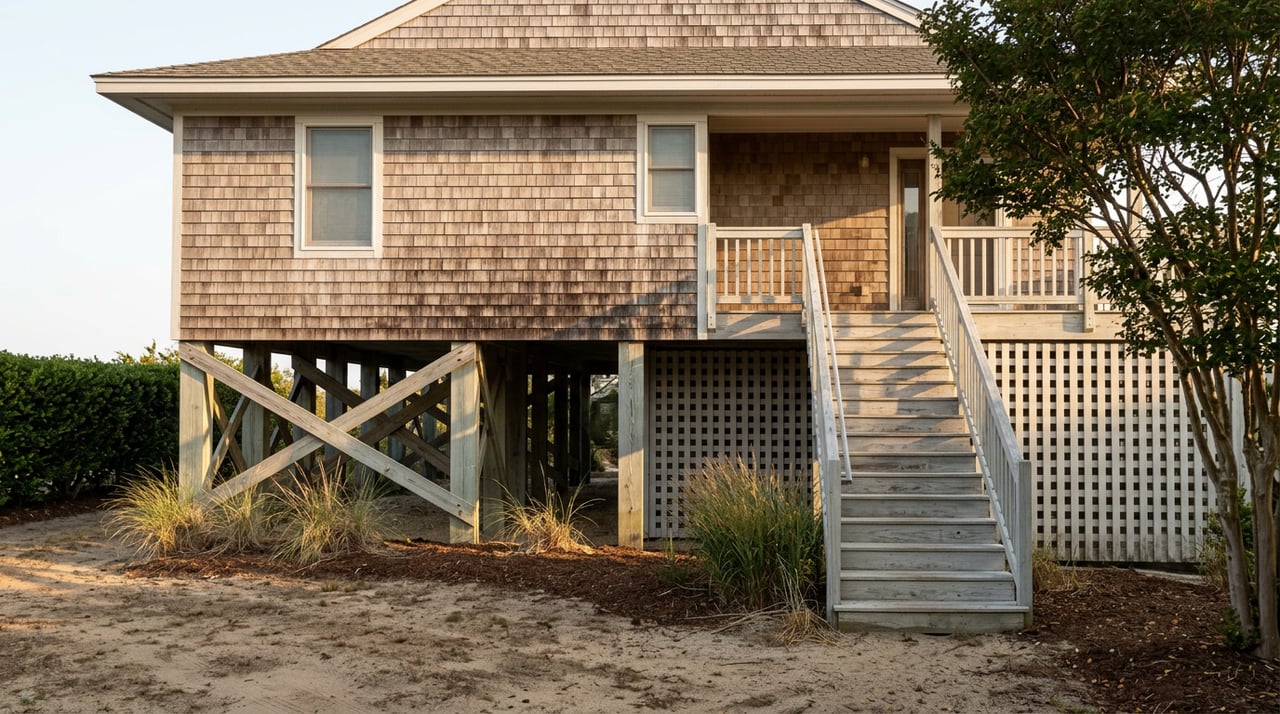
Most buyers walk into a flood zone conversation expecting a discount. Risk should cost you something, the thinking goes, so a home sitting in FEMA's highest-risk coastal designation ought to trade below a comparable house a few blocks inland. In Quogue, the opposite happens. An analysis of Southampton Township home sales between 2021 and 2025 found that properties in FEMA Zone VE, the designation reserved for beachfront exposed to storm-wave action, sold at a 79 percent premium over non-flood-zone comparables in Quogue. In neighboring Westhampton Beach, the premium climbed to 121 percent.
That number should stop you before you write an offer. It means the extra risk isn't priced out of these homes. It's priced in, and buyers are paying more, not less, to take it on.
Ask why, and the honest answer has less to do with flood modeling than with scarcity. Quogue's waterfront lots on Dune Road, along the Quogue Canal, and fronting Shinnecock Bay are finite in a way that inland lots simply aren't. The village has held to low-density zoning for decades, and a meaningful share of its waterfront homes have stayed inside the same families for a generation or more. When one comes to market, buyers aren't just bidding on square footage. They're bidding on direct water access, a dune-protected sightline to the Atlantic, and a piece of inventory that may not reappear for years.
That scarcity premium is durable enough to override the risk discount you'd expect. It's also exactly the kind of number a listing sheet won't explain, because a listing sheet shows you the price, not the reason for it.
Here's where the math gets uncomfortable. Paying more for VE-zone waterfront doesn't mean you're buying more insurance protection. It often means the opposite.
The National Flood Insurance Program caps building coverage at $250,000 per structure. That ceiling was set with a very different housing stock in mind. On a multi-million-dollar Quogue waterfront home, a $250,000 payout barely covers the demolition phase of a serious flood claim, let alone a full rebuild. Buyers of high-value coastal property routinely have to layer private excess flood coverage on top of their NFIP policy, sourced from carriers like Nephila or Lloyd's syndicates, just to close the gap between what a policy pays and what the house is actually worth.
FEMA changed how it prices this risk too. Since April 2022, the agency's Risk Rating 2.0 methodology has calculated premiums off individual property characteristics rather than a flat zone rate: distance from water, foundation type, first-floor elevation relative to base flood elevation, and replacement cost all factor in separately now. Two houses on the same block, on the same FEMA map, can carry meaningfully different premiums depending on how each one was built. That also means the quote a seller shares from three years ago may no longer reflect what you'd actually pay at closing.
The Village of Quogue's own flood damage prevention code incorporates these same FEMA zone designations directly into local building law, which is why elevation requirements and construction standards for a VE-zone lot can differ from an AE-zone lot two streets away. If you're comparing two waterfront properties, the zone letters on the map aren't a formality. They're doing real work in what you'll be required to build, insure, and maintain.
There's a second piece of friction that rarely comes up until underwriting, and it matters more in Quogue than almost anywhere else because of how the village actually gets used. Most homes here are closed for the season, typically from Labor Day through Memorial Day. That's exactly when a frozen pipe is most likely to burst, and exactly when nobody is around to notice.
Standard homeowners policies frequently include vacancy exclusions that limit or eliminate coverage once a property has sat unoccupied for 30 to 60 consecutive days. A pipe that fails in January in a closed Quogue house may not be discovered until the owners reopen it in May. By then, what would have been a straightforward water extraction can escalate into a full demolition and rebuild, the difference between a five-figure repair and a project well north of $40,000. That gap has nothing to do with the flood zone premium and everything to do with how the policy defines "occupied."
If you're buying a seasonal property here, the vacancy clause deserves the same scrutiny as the flood policy. Ask the seller's carrier directly how many consecutive unoccupied days trigger a change in coverage, and don't assume your existing homeowners policy from a year-round primary residence will transfer its assumptions to a house you'll close for eight months a year.
Quogue's current market makes the volatility around these numbers easy to see. Village-wide, 2026 listing data has put the median home price anywhere from the mid-$2 millions to the mid-$4 millions depending on the month and the mix of homes that closed, with active single-family listings this summer ranging from just over $1 million to nearly $20 million. Waterfront-specific listings carried a median asking price around $5.5 million as of early June 2026.
That spread isn't noise. It's a symptom of a market with genuinely low transaction volume. In July 2026, 21 single-family homes closed in the village, up from 16 the year before, and a count that small means one outsized deal can move the median significantly. A four-level oceanfront home on Dune Road listed at $15 million in January 2026 is the kind of single sale that, once it closes, can pull an entire month's median upward on its own. When you're comparing "the median" across two neighborhoods or two months, you're often comparing very different sample sizes, not a stable trend line.
Recent risk modeling also puts close to half of Quogue's properties within a 30-year severe flood exposure window, with wind exposure over the same horizon rated as severe across the entire village. None of that is a reason to avoid the water here. It's a reason to price your insurance and maintenance budget off the specific property, not off the village average.
Does every property in Quogue require flood insurance? Only if it sits in a FEMA Special Flood Hazard Area and carries a federally backed mortgage. Village code ties directly to FEMA's zone maps, so the requirement is determined property by property, not village-wide.
If the risk is real, why do buyers keep paying more for it? Scarcity. Direct water access and dune-protected waterfront in a low-density village don't come back on the market often, and buyers have consistently priced that access above the discount a risk model would otherwise suggest.
Can my insurance costs change after I close? Yes. Risk Rating 2.0 recalculates premiums at renewal based on the property's individual risk factors, so a rate you're quoted at closing isn't locked in permanently.
Numbers like these are exactly why we spend as much time on underwriting mechanics as we do on curb appeal. If you're weighing a waterfront purchase in Quogue and want the real cost picture before you write an offer, not after, Stoebe & Co. can walk you through it. Get on the VIP list to have the next market read delivered before it hits the search results.

Stoebe & Co. Real Estate is a premier, independently owned brokerage located in the prestigious Village of Westhampton Beach. With over $1 billion in sales, the firm has established itself as a leader across the primary, luxury, ultra-luxury, rental, and commercial markets. Our growth is the result of a deliberate approach to real estate — one defined by clarity, precision, and purpose.
October 1, 2026
September 24, 2026
September 17, 2026
September 17, 2026

September 10, 2026
September 3, 2026
August 27, 2026
August 27, 2026
August 20, 2026