
November 26, 2026
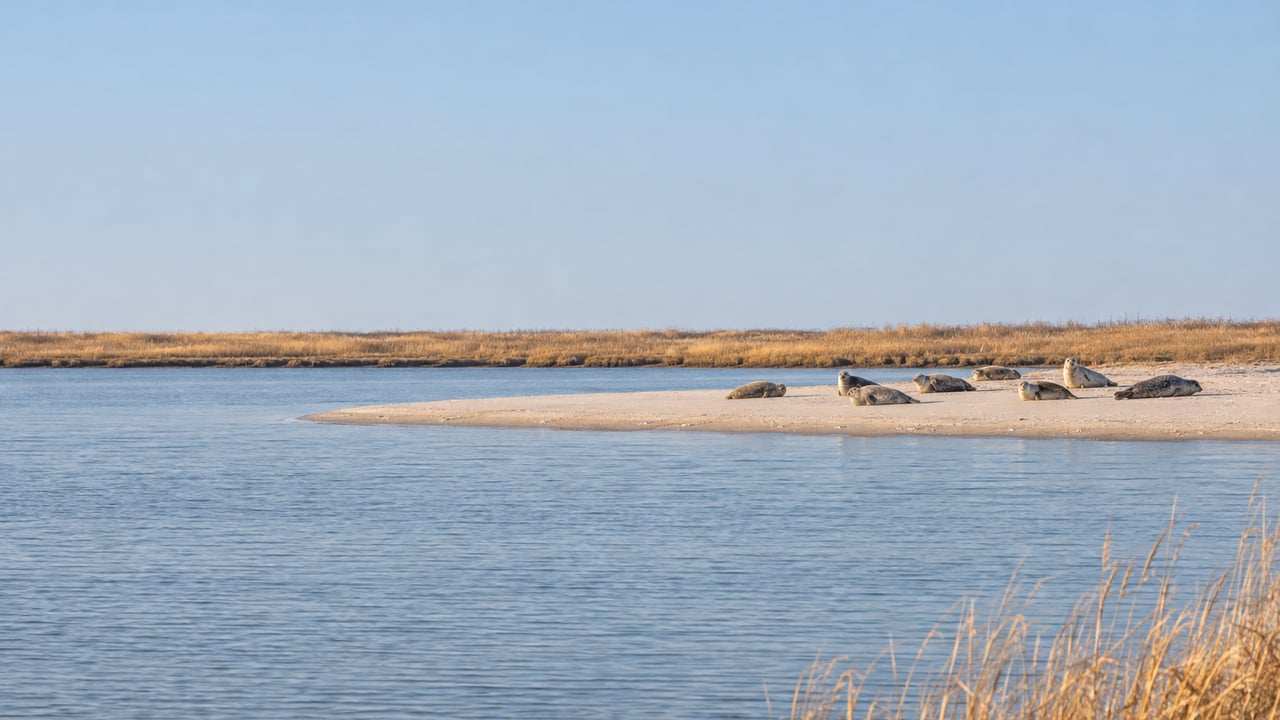
On Sunday, January 4, 2026, the weather was mild and the wind was light at the west end of Dune Road. Somewhere between 45 and 55 harbor seals had hauled out on the Moriches Bay sandbar north of Cupsogue Beach County Park. They were roughly 500 yards from the group watching them. About half an hour in, a small outboard boat drove straight at them and the seals scattered into the water. As they went, one male swam close enough for an identification photo. Researchers call him "Horseshoe," and that photo was his 160th recorded sighting in 21 years, as logged in the Coastal Research and Education Society of Long Island's 2025–26 Cupsogue reports.
That morning sums up the Westhampton Beach seal season as it stands this Thanksgiving. The seals still come back, the same animals return year after year, and the count on a good morning is still impressive. Over two decades, though, the seals have moved farther from the people who come to watch them. Seeing them well now depends on optics, weather and keeping your distance.
CRESLI is a Long Island research nonprofit. Its co-founder, president and senior scientist, Dr. Artie Kopelman, has recorded the Cupsogue seals since 2006. As of its 2026–27 season page, the group has documented 33,157 seal encounters at Cupsogue Beach over 574 trips, which works out to roughly 58 per outing across 20 years. CRESLI describes the seals as typically present for about seven months, November through May. It adds that the average number seen per sighting changes from month to month.
Nearly every one of those animals is the same species. From 2006 through 2025, CRESLI's Cupsogue tally counts 32,960 harbor seal encounters, against 139 gray seals, 11 harp seals and a single hooded seal. A gray seal at Cupsogue is a real occasion. The usual winter sight off Dune Road is a line of harbor seals resting on the sandbar.
Last season shows the range a single winter can cover. On New Year's Day 2026, cold and strong northwest winds left the bay empty. That was the first time in 572 trips over 20 years that CRESLI saw no seals at all. Three days later came the 45-to-55-seal morning. CRESLI logged more than 100 seals on the sandbar on March 13 and 66 on March 29. On April 11 it found about six seals at one end of the sandbar and about 60 at the other. A yearling gray seal was among them. The new season is already underway. On November 4, 2026, Kopelman photographed 20 to 25 harbor seals hauled out from roughly 400 yards away.
CRESLI calls the place where the seals rest a "haul-out." Over the years it has named a sequence of them on the same sandbar. First came the "primary" area on the western end, then secondary and tertiary areas, then the "quaternary" area. The current favorite is what CRESLI calls the "quinary" area, the fifth, on the far northeast part of the sandbar. CRESLI's reports put the seals there at about 400 to 500 yards from where observers stand.
In its November 30, 2025 report, CRESLI attributed the move to "disturbance and dramatic changes in the sandbar" over 21 years of observation. The old primary area has not been abandoned altogether. CRESLI still described the March 13 morning, when more than 100 seals hauled out on the original primary area, as "a rare occurence these days."
That shift is the most useful thing a Westhampton Beach resident can know before driving out. On most mornings the seals will be in the far northeast corner of the sandbar, well beyond what the naked eye can make out. If you arrive expecting to see them close up from the parking lot, you will probably see an empty-looking bay.
CRESLI's own season reports show that the seals react to the bay's ordinary traffic, not only to people on foot. On November 30, 2025, a group of three clammers working with a small boat about 30 yards west of the haul-out kept flushing seals off the sandbar. On March 29, 2026, a small motorized fishing boat moving fast along the shore flushed about a third of the seals. They came back, and then an aircraft passing near the area flushed them again. CRESLI notes that the seals learn the sounds of things that have disturbed them before.
The guidance is the same for anyone on the beach or on the water in Moriches Bay this winter. NOAA Fisheries' marine life viewing guidelines ask people and pets to stay at least 50 yards, or 150 feet, from seals on shore or in the water. They also ask you to back away if a seal shows signs of agitation. CRESLI's own reports end with the same request to observe resting seals from at least 150 feet away. If you live on the bay and launch a boat in the off-season, the far northeast end of the Cupsogue sandbar is the part to give a wide berth from now through spring.
Cupsogue Beach County Park is at 975 Dune Road. Suffolk County directs visitors to follow Dune Road to its western end, past the Village of Westhampton Beach. The county's posted beach parking fees apply in season, which it defines as Memorial Day through Labor Day, 8:30 a.m. to 5 p.m. There are no bathroom facilities at the park in winter. Newsday's seal-watching guide and CRESLI both mention this, so plan to stop in the village first.
CRESLI's own route starts at the western end of the parking lot. The group walks west along the sand road, turns north at the first turnoff and continues toward the bay. Then it walks east in single file along the far edge of the sand. The round trip is about 1.2 miles and takes roughly an hour to an hour and a half. CRESLI describes it as suitable for children.
Equipment makes the outing. Kopelman photographs the haul-out with a long lens that reaches the equivalent of 1200mm, and CRESLI strongly suggests bringing your own binoculars. At 400 or 500 yards, binoculars or a spotting scope is what lets you count seals instead of guessing at dark shapes. CRESLI's advice on clothing is just as direct: assume the wind will add a chill, and wear layers, a hat, gloves and warm shoes. The 2025–26 reports point to weather as the single best predictor. The empty New Year's Day came with cold, strong northwest winds. The 45-to-55-seal morning three days later had warm conditions and little wind. CRESLI links its weather forecast for Cupsogue Beach from its seal page, and it is worth checking before you head out.
If you would rather have an expert at the scope, two local nonprofits publish their own winter programs. CRESLI posts its Cupsogue walk schedule, reservation forms and season reports at cresli.org/seals. It brings spotting scopes and digital cameras with viewing screens for participants to use. The Atlantic Marine Conservation Society lists its own seal cruises on Shinnecock Bay. Both organizations require reservations, so check their pages directly for dates.
CRESLI also runs cruises on Shinnecock Bay, and as of April 25, 2026 it had documented 3,309 seal encounters over 35 Shinnecock Bay trips. That averages about 96 seals per trip. Those numbers come from a boat, so they don't compare directly with walks along the Cupsogue shore. They do show that the East End's winter seal population isn't limited to one sandbar off Westhampton Beach.
The same 50-yard guidance from NOAA covers a seal you come across on any beach, and it applies to pets as well as people. If an animal looks sick or injured, the Atlantic Marine Conservation Society asks the public to call the New York State Stranding Hotline at 631-369-9829. Last April's yearling gray seal at Cupsogue is the kind of case the hotline handles. CRESLI described it as foaming at the mouth, with an apparently injured left eye.
For homeowners who spend part of the winter away, the hotline number is worth adding to the notes left for a caretaker or house-sitter, along with the boat, the alarm code and the heating contact.
Saturday mornings in the off-season already have a routine in the village, from the winter farmers market at St. Mark's to coffee on Main Street. Between now and May, a calm, clear morning is also a good one for the walk to the sandbar at the far end of Dune Road. Bring binoculars and dress for the wind.
Stoebe & Co. works with second-home owners across Westhampton Beach through the off-season. If you would like a winter checklist for your property, stranding hotline included, or want to know what's happening on the East End while you're away, get on the VIP list.

Stoebe & Co. Real Estate is a premier, independently owned brokerage located in the prestigious Village of Westhampton Beach. With over $1 billion in sales, the firm has established itself as a leader across the primary, luxury, ultra-luxury, rental, and commercial markets. Our growth is the result of a deliberate approach to real estate — one defined by clarity, precision, and purpose.
November 26, 2026
November 19, 2026
November 12, 2026
November 12, 2026
November 5, 2026
October 29, 2026
October 29, 2026
October 22, 2026
October 15, 2026